Articles
Cycling Solo from Canada to Mexico – The US Food Deserts

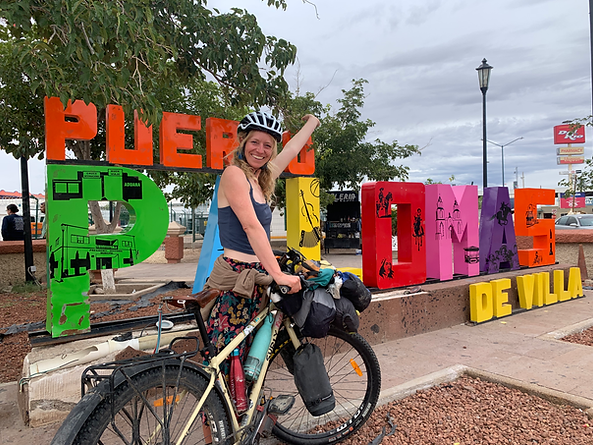
In the summer of 2025, the day after my dad’s funeral, I flew to Canada to cycle 2,700 miles from Banff, Alberta to Puerto Palomas, Mexico (Columbus, New Mexico is the US border town). The route followed the Rocky Mountains, and boy were they rocky! The elevation gain was 150,000 feet – that’s five Mount Everest mountains. As a biologist, researcher and environmentalist, I wanted to explore these beautiful wild lands, and see how things were out there in the states. Amidst the incredible scenery, the raw nature and the kindness of locals, the problems were big…
The first difficulty to present itself to me were the food deserts. Mis-shapen fruits and veges left through kindness in a box for cyclists at the local diner by the owner of a fresh produce company, were the only fresh produce in Lima, Southern Montana for example. We had to stock up for the next five days of cycling at a petrol station, selling plastic cheese, beef jerky, gator aid and M&M’S. Nothing says 'Fresh "Produce' quite like a cigarette sponsored shopping basket. To make matters worse, the lights went out so I had to try and read ingredients labels to decipher which 'food like substances' were going to take the least years off my life. I chatted to a local as I stroked her dog, about her current cancer treatment, whilst she told me “I’m too mean to die” and I held the door of the petrol station open to an old fella who slowly shuffled his way in to do his weekly shop – clearly too old to drive to a supermarket where anything green might present itself.
It seems in the states, filling stations are more important for cars, than filling stations for people. The 119 mile cycle from Cuba to Grants through the Navajo nation reservation in New Mexico, was supplied by two petrol stations, and the closest supermarkets were over 50 miles away. I was kindly taken in by one of the local residents, who had eaten beans for his last three meals due to the lack of food availability; it wasn’t much of an offer, but Uncle Ben’s re-hydrated rice and pesto in a wrap was a welcome treat cycled from Cuba.
And this wasn’t the only time the water was undrinkable; the now abandoned Summitville gold-mine site at Indiana Pass in Southern Colorado, still discharges toxic substances into the soil and water. After having learnt my lesson, this time I carried eight litres of water, up to a peak of 12,000 feet. With my bike weighing 55 KG, and my own body weight dropping to 62 KG, this was an incredibly difficult time. The five days of thunder, lightning and torrential rain didn’t help.
Unreliable water sources in the Jemez Mountains of New Mexico, meant I ran out of water. I was assured by a local that a river 30 miles in from running… “One hundred percent that creek is running, I saw it with my own eyes only yesterday”… It wasn’t running. Luckily there was some surface water in the form of rainwater puddles on the ground, which really got me out a sticky situation! Time after time in New Mexico, water from rivers which I relied upon, were often putrid from cattle, or fenced-off with barbed wire by the cattle farmer, to keep the wild animals and us cyclists from this life-line.
This trip has inspired me to research solutions to these food deserts and access to fresh water for wildlife… watch this space!